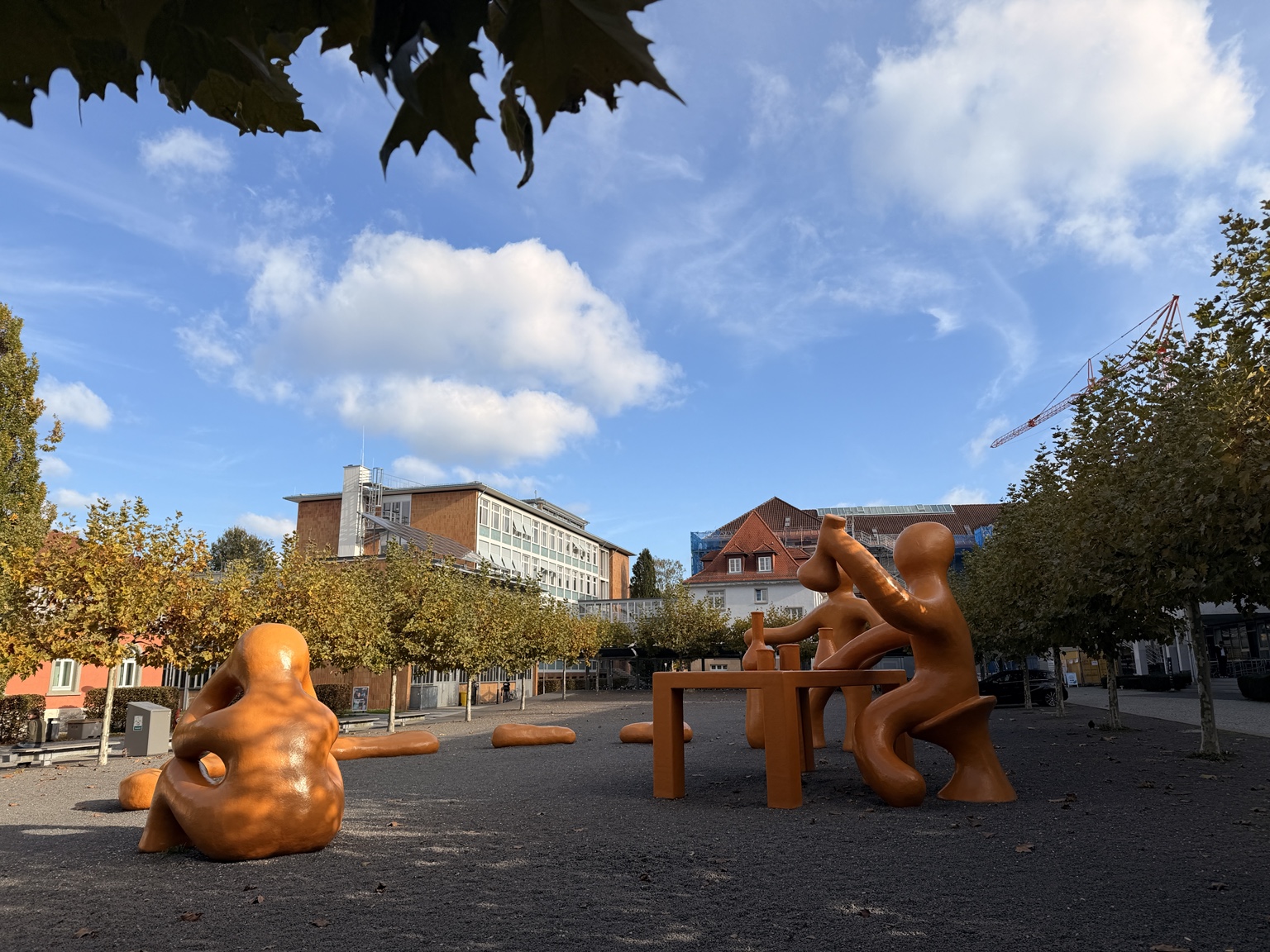
In the photograph taken on 29 October, three orange figures in the HTWG courtyard immediately draw the eye. The City of Konstanz lists the installation as “The Scientists” and describes the figures as symbols of research, reflection and discovery. The work stands between building F and the library. It offers a fitting way to look at the university: campus life takes place not only in lecture halls and laboratories, but also in the spaces between them.
120 years of higher education in Konstanz
The HTWG’s history began in 1906. Engineer Alfred Wachtel founded the Technikum Konstanz, which started with 28 students and four lecturers in the rear building at 17 Hussenstrasse. Electrical and mechanical engineering were its initial subjects. In 1911 the school moved to a building by the Rhine, which today houses the Faculty of Civil Engineering and architecture programmes. 2026 is a jubilee year: for 120 years, the university has helped shape Konstanz and the region. The small technical school grew into today’s Hochschule Konstanz – Technik, Wirtschaft und Gestaltung (Konstanz University of Applied Sciences).
Six faculties, applied learning
Today HTWG comprises six faculties: Architecture and Design, Civil Engineering, Electrical and Information Engineering, Computer Science, Mechanical Engineering, and Business, Cultural and Legal Studies. The university describes its profile as application-oriented, bringing together theory and practice, interdisciplinary collaboration and an international outlook. According to an announcement dated 6 October 2026, around 900 new students started bachelor’s and master’s programmes that October. HTWG says students can apply what they learn through practical projects and take part in opportunities beyond their own department.
Art as part of campus life
The installation was created by Dutch artist Joep van Lieshout and handed over on campus on 11 April 2003. According to HTWG, using the work as a meeting place is part of its concept: it is meant to be part of everyday life on the forum, rather than an exhibit viewed from a distance in a museum. The figures put that idea into view. Set among trees and university buildings, the courtyard invites people to pause, meet or simply pass through.
The campus’s position on the Seerhein in the Paradies district adds to the university’s character. But a campus is defined by more than its view. Practical projects and places where people from different disciplines can meet also matter. The orange figures make that connection visible: they remind us that learning grows from questions, exchange and discovery, both inside and beyond the classroom.